Small businesses are using AI faster than ever. What once felt like advanced technology for large companies is now part of everyday work for small teams, local businesses, startups, and solo founders. From writing emails and creating marketing content to managing customer support and automating admin tasks, AI can help small businesses move faster without adding more staff.
That is why more owners are searching for the best AI tools for small businesses. They want tools that are practical, affordable, easy to use, and built to solve real business problems. The goal is not to add more software just for the sake of it. The goal is to save time, reduce manual work, improve quality, and grow more efficiently.
In this guide, I will break down the top categories, the most useful tools, and how to choose the right setup for your business.
Why Small Businesses Are Using AI More Than Ever
Small businesses often work with limited time, limited budgets, and lean teams. Owners usually manage multiple roles at once. They may be handling sales, marketing, customer service, operations, and invoicing in the same week. That pressure is one of the main reasons AI tools for small business owners are growing so quickly.
AI helps by taking over repetitive tasks. It can draft content, summarize meetings, improve customer replies, generate ideas, analyze data, and support faster decision-making. Instead of hiring a full team for every function, small businesses can use smart tools to cover more ground.
Another reason AI is gaining traction is accessibility. Many tools now offer simple dashboards, low-cost monthly plans, free trials, and no-code features. That makes them much easier for smaller businesses to adopt.
What Makes an AI Tool Good for a Small Business?
Not every AI tool is worth paying for. The best options for small businesses usually share a few important qualities.
First, they are easy to learn. A small team does not have time for a long setup or a difficult training process. Second, they solve a clear problem. Good tools help with writing, design, customer support, scheduling, lead management, or workflow automation. Third, they offer strong value for the price. A small business should be able to see a real return, either in saved time, better output, or more revenue.
Good integrations also matter. The best small business AI tools work well with common platforms like Gmail, Slack, Shopify, QuickBooks, HubSpot, WordPress, and Google Workspace.
Best AI Writing and Content Tools
Content is one of the easiest places for small businesses to use AI well.
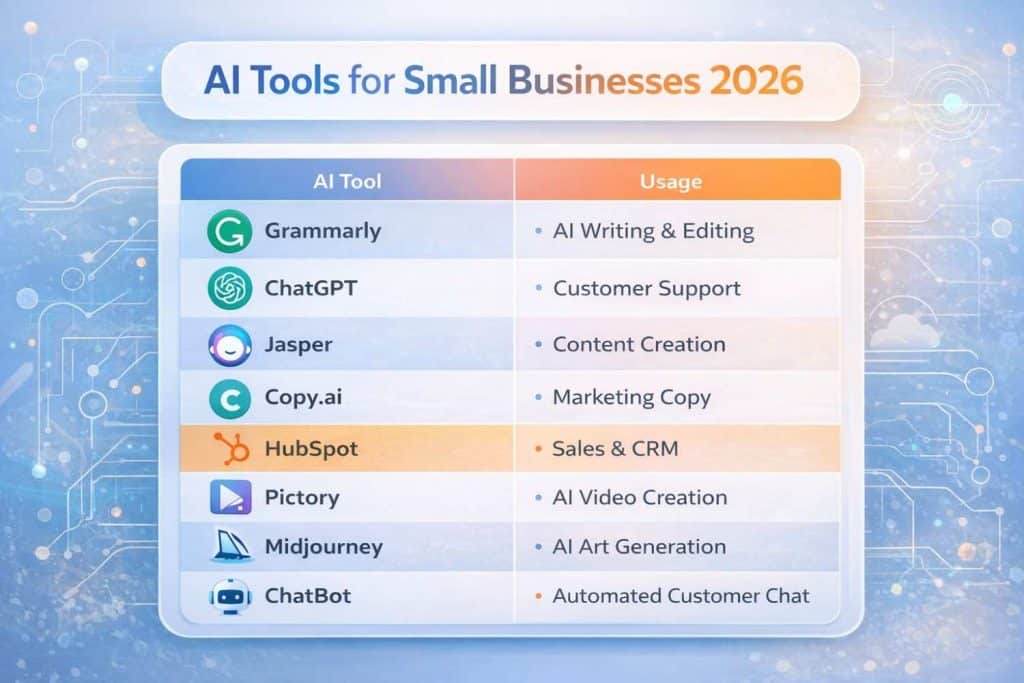
ChatGPT is one of the most flexible options. Small business owners use it to write blog posts, email drafts, product descriptions, FAQs, ad copy, and social media captions. It is also useful for brainstorming, summarizing, and rewriting text in a clearer tone.
Jasper is more focused on business and marketing workflows. It is useful for brands that want templates, structured campaigns, and repeatable content systems.
Copy.ai works well for quick copy generation, especially for sales and marketing tasks. It is often a strong option for short-form writing.
Grammarly is still one of the most useful AI tools for polishing communication. It helps with grammar, clarity, tone, and professional writing, which makes it especially useful for emails, proposals, and website content.
For most small businesses, writing tools are a smart first step because they are easy to use and create immediate value.
Best AI Tools for Marketing and SEO
Marketing is another area where AI can make a huge difference.
Canva is one of the best tools for small businesses because it combines design simplicity with AI-powered features. Owners can create social graphics, presentations, flyers, and ads without advanced design skills.
Surfer SEO is helpful for businesses that publish blog content and want to improve search visibility. It supports keyword-focused writing and content optimization.
Semrush now includes AI-supported features that can help with keyword research, planning, and content strategy. For small businesses that depend on organic traffic, this can be valuable.
HubSpot AI tools help with email writing, CRM tasks, and marketing workflows. This is especially helpful for growing teams that want one platform for lead generation and follow-up.
If a small business wants more traffic and better campaign output, AI marketing tools can save hours every week.
Best AI Tools for Customer Support
Small businesses are expected to reply faster than ever, even with tiny support teams. That is where AI support tools can help.
Freshdesk Freddy AI is a good option for businesses that want simple automation, suggested replies, and support workflows without a heavy setup process.
Tidio is popular with smaller ecommerce and service businesses because it combines live chat and automation in a user-friendly way.
Intercom is often better for SaaS or digital-first businesses that need product support and smarter customer conversations.
Zendesk AI is stronger for larger support operations, but some growing small businesses may still consider it if they want a more advanced system.
The best support tools help reduce response time, answer common questions, and improve customer experience without increasing staffing costs.
Best AI Tools for Productivity and Operations
AI is also becoming a strong productivity layer for everyday business work.
Notion AI helps with internal documentation, idea generation, meeting notes, and project planning. It is useful for businesses that want one place to organize information.
ClickUp AI supports project management, summaries, task creation, and workflow planning. It is a strong option for teams that manage multiple moving parts.
Otter.ai and Fireflies.ai are especially useful for meeting transcription and summaries. Small businesses can use them to capture client calls, internal meetings, and brainstorming sessions without manual note-taking.
Zapier AI helps connect tools and automate workflows. This is useful when a business wants tasks to move automatically between apps, such as sending lead data from forms into a CRM or triggering follow-up emails.
These tools may not be flashy, but they often create some of the biggest time savings.
Best AI Tools for Sales and CRM
Small businesses that rely on outreach and follow-up can benefit a lot from AI in sales.
HubSpot AI supports lead management, email drafting, and CRM productivity. It works well for businesses that want a cleaner sales pipeline.
Pipedrive AI helps teams organize opportunities and move leads through the funnel more efficiently.
Zoho AI is another option for businesses already using Zoho tools for operations and customer management.
AI in sales is not just about automation. It is about faster response, better follow-up, and more consistency in communication.
Best AI Tools for Design and Branding
Visual content matters, especially for small businesses trying to look professional online.
Canva stands out again here because it is easy, affordable, and built for non-designers. It can help with logos, social posts, brochures, pitch decks, and ads.
Adobe Express AI is another strong option for quick branded visuals.
Looka can be helpful for businesses that want AI-assisted logo and brand kit creation.
For businesses that need fast visual output without hiring a full-time designer, these tools offer strong value.
How to Choose the Best AI Tools for Your Small Business
The best approach is to start with your biggest problem. Do not begin with a long list of tools. Begin with the task that wastes the most time or slows down growth.
If writing takes too long, start with a content tool. If customer replies are slow, test a support tool. If your team loses time in meetings and scattered notes, choose a productivity tool first.
Next, compare pricing against expected value. A tool that saves five hours a week may be worth much more than a cheaper tool that adds little improvement. It is also smart to check integration support. The right tool should fit into your current workflow, not force you to rebuild it.
Free trials are important too. Many AI tools look similar in marketing, but the real difference appears in ease of use and output quality.
Common Mistakes to Avoid
One common mistake is subscribing to too many tools too quickly. Small businesses often get excited about AI and end up paying for overlapping products. That creates unnecessary cost and confusion.
Another mistake is expecting AI to replace human judgment. AI works best as a support layer, not a full replacement for strategy, customer empathy, or final review.
It is also important not to ignore privacy, data handling, and workflow fit. A tool may look impressive but still be wrong for your business if it does not connect with your systems or support your actual daily needs.
Are Free AI Tools Enough?
Free AI tools can be enough for some early-stage businesses. They are great for testing content generation, basic design, and light productivity support.
However, free plans usually come with limits. You may face usage caps, fewer integrations, weaker collaboration features, or reduced customization. As your business grows, paid plans often make more sense because they save more time and offer more control.
A good strategy is to start free where possible, then upgrade only when the value is clear.
Final Thoughts About Best AI Tools for Small Businesses
The best AI tools for small businesses are the ones that solve real problems, not the ones with the most hype. For some businesses, that means using ChatGPT and Canva to improve content and design. For others, it means adding Tidio for support, Notion AI for workflow management, or HubSpot AI for sales follow-up.
The smartest move is to start small, measure results, and build your stack based on actual needs. AI can help small businesses save time, improve quality, and grow faster, but only when the tools are chosen carefully and used with purpose.