If you felt like your AI writing assistant got noticeably smarter over the last thirty days, you aren’t imagining things. April 2026 has been a watershed month for the content creation industry.
We have officially crossed the threshold from “prompt-assisted drafting” into the era of “autonomous content agents.” This month saw major underlying model updates, a fierce price war among dedicated platforms, and a significant shift in how search engines handle AI-generated content.
Here is your complete roundup of the most important AI writing tool updates, new feature drops, and industry shifts that happened in April 2026.
The Big Three: Foundation Model Updates (The Engines)
Before looking at the apps you use daily, we have to look at the engines powering them. April saw massive updates from the top three AI labs.
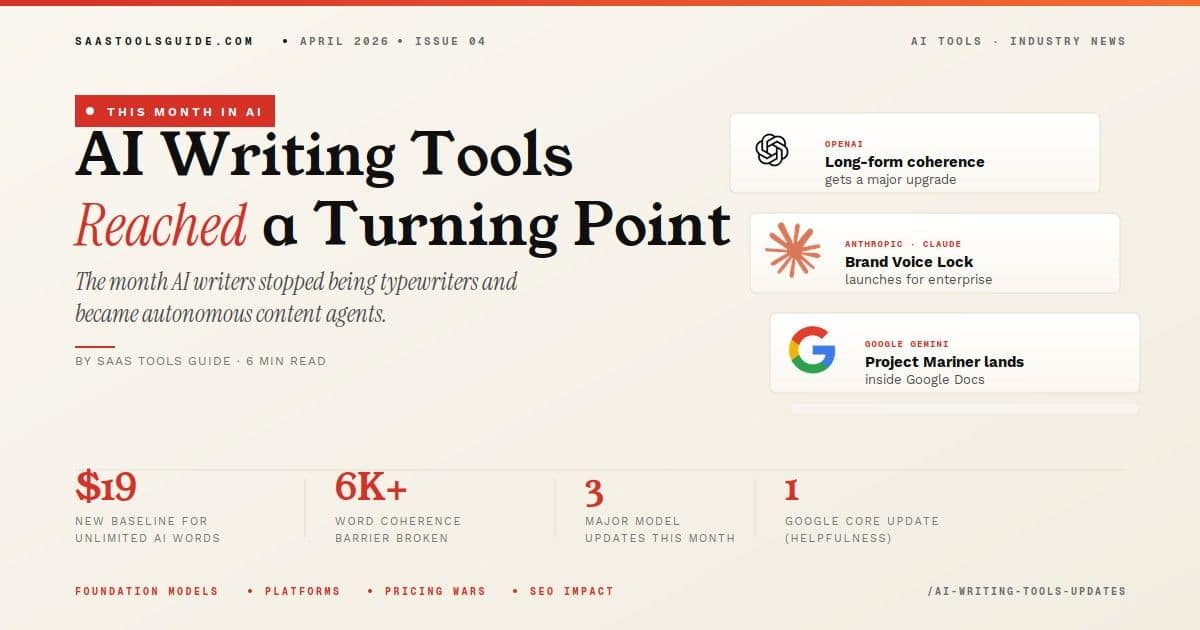
OpenAI’s April Moves: Fixing the “Lost the Plot” Syndrome OpenAI quietly rolled out its mid-cycle API update this month, specifically targeting long-form coherence. Previously, even the best models tended to drift off-topic or lose character consistency around the 6,000-word mark. The April patch introduces a new “context threading” architecture. Third-party writing tools plugged into the OpenAI API are already seeing drastically reduced hallucinations in long-form articles and eBooks.
Google Gemini’s Workspace Integrations Google didn’t hold back. Gemini 2.0’s capabilities are now deeply woven into Google Docs and Sheets. The biggest April 2026 news here is the native rollout of “Project Mariner” inside Docs. You can now highlight a section of text, tell Gemini to “find supporting data for this online,” and the AI will browse the live web, extract the data, and rewrite the paragraph with inline citations—without ever leaving the document.
Anthropic Claude’s Focus on “Safe” Brand Writing Anthropic released its highly anticipated “Brand Voice Lock” feature for Claude. While Claude has always been the writer’s favorite for nuance, this update allows enterprises to upload a style guide and enforce it at the API level. Claude will now actively refuse to generate text that deviates from the requested brand tone, effectively solving the “AI-sounding” problem for corporate clients.
Major Updates to Dedicated AI Writing Platforms
With the underlying models getting smarter, dedicated writing platforms had to prove their value beyond just being a wrapper. They did so by leaning into automation.
Jasper AI: The Shift to Fully Autonomous Campaigns Jasper officially launched its “Campaign Agent” this month. Instead of asking Jasper to write a single blog post, users can now input a broad goal (e.g., “Generate a month-long launch campaign for our new vegan protein powder”). The agent autonomously researches the competition, drafts the SEO blog posts, writes the social media variations, generates the marketing emails, and pushes them directly to your CMS and social schedulers.
Copy.ai & Jasper: The B2B Battle Heats Up Not to be outdone, Copy.ai released “Salesforce Sync 2.0” in mid-April. The update allows the AI to pull live CRM data to automatically draft hyper-personalized RFPs and sales proposals. The AI doesn’t just use a template; it reads the prospect’s recent company news mentions from the CRM and weaves them into the pitch.
Writer.com: Enterprise Guardrails Writer.com, the darling of the enterprise space, dropped a massive update to its “Fact-Check Shield.” Now, as the AI drafts content, it cross-references every single statistic and claim against your company’s internal wiki. If it can’t verify a claim internally, it flags it in red before you even hit “generate.”
Sudowrite & NovelAI: Updates for Fiction Writers Fiction authors got some love, too. Sudowrite released “StoryBrain” in April—a localized memory context window specifically trained on narrative structures. It can now track a fantasy series’ complex magic system and sprawling cast of characters over 100,000 words without needing constant reminding.
The Hottest New Features Dropping in April 2026
Beyond specific brands, a few overarching capabilities became industry standards this month.
Multimodal-to-Text Workflows Tools like Notion AI and Writesonic pushed major updates allowing users to dump raw, messy inputs into the AI. You can now upload an hour-long Zoom whiteboard recording, a messy voice-memo transcript, and a scattered PDF, and tell the AI to synthesize it into a polished, 2,000-word strategy brief.
“Deep Research” Comes to Content Drafting Following Perplexity’s lead, almost every major writing tool now features live-research agents. The era of AI writing making up fake URLs is ending; April 2026’s tools browse the live web, extract quotes, and append real, clickable footnotes to the bottom of generated articles.
Dynamic Style Transfer The dreaded “mega-prompt” is dying. This month saw the mainstream adoption of one-click style transfer. You simply upload three PDFs of your own past writing, click “Analyze,” and the AI perfectly mimics your sentence structure, humor, and vocabulary without you having to write a single line of prompt engineering.
Pricing Shifts & Market Moves (The Business News)
Are Subscription Prices Dropping? Yes. Because the cost of running foundation models has plummeted, we are seeing a price war. In April, several mid-tier tools dropped their “Unlimited” tiers from $49/month down to $19/month. “Unlimited AI words” is now a baseline expectation, not a premium luxury.
New Entrants & Acquisitions In a surprise move, Grammarly acquired a small AI video-to-text startup to build out its multimodal editing suite. Expect to see Grammarly not just fixing your grammar soon, but actively rewriting your video scripts based on your raw, unedited video uploads.
SEO & Google’s Stance in April 2026
Of course, none of these tools matter if Google won’t rank the content.
Early April saw the rollout of the “April 2026 Helpfulness Core Update.” The verdict is in: Google still doesn’t penalize content simply because a machine wrote it. However, this update aggressively targeted “synthesized summaries.” If an AI tool just regurgitates the top 3 search results without adding primary data, unique insights, or original images, it was buried in April’s update. The message is clear: AI writers must be used to augment expertise, not fake it.
What These April Updates Mean for Content Creators
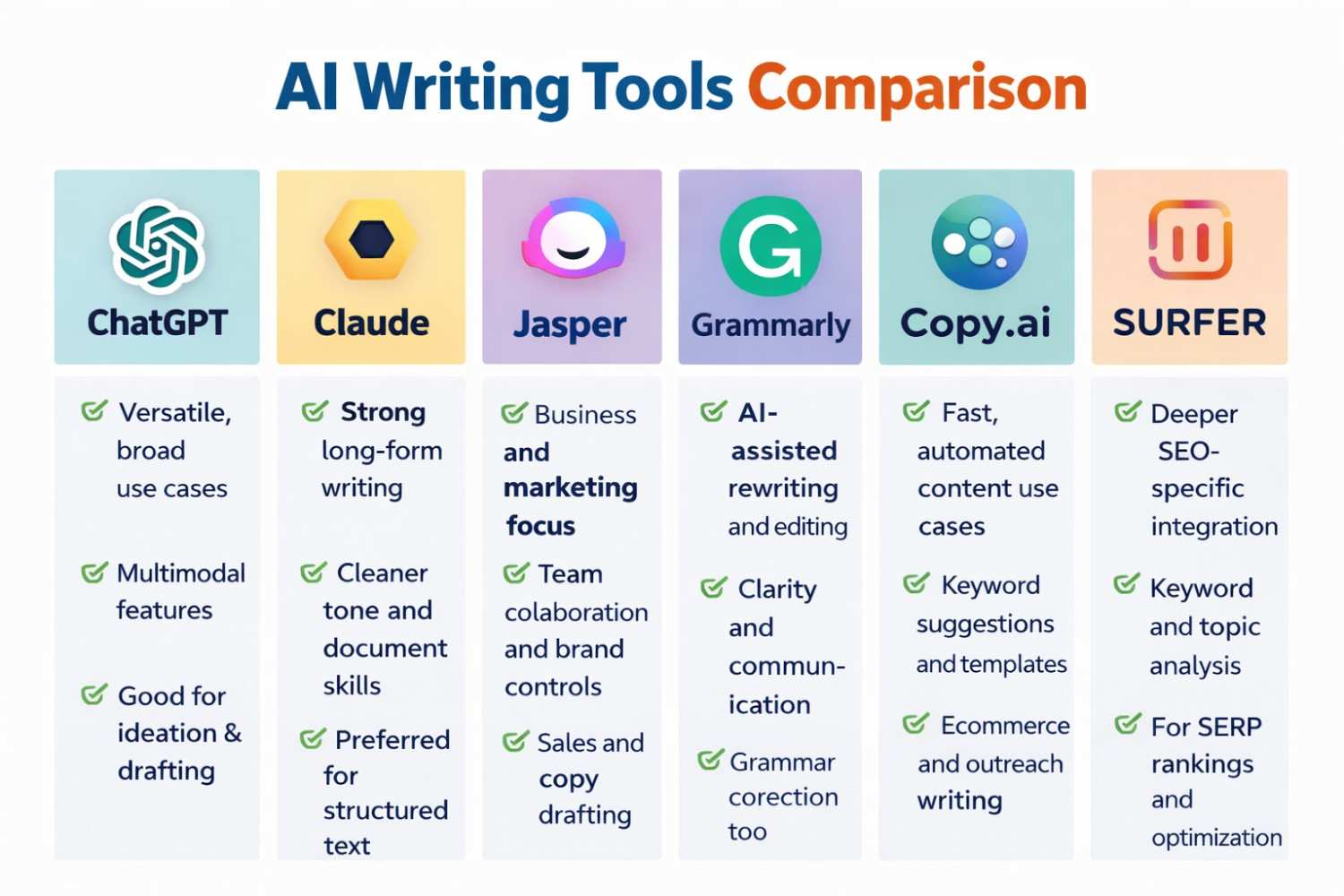
Who Should Switch Tools? Based on this month’s news, the lines are drawn. If you are in B2B sales or marketing, Copy.ai’s CRM integrations make it the undisputed king right now. For fiction authors, Sudowrite’s StoryBrain is a must-have. For agencies managing massive SEO campaigns, Jasper’s autonomous Campaign Agent will save you dozens of hours.
How to Adapt Your Workflow Stop thinking of yourself as a “prompt engineer.” The April 2026 updates prove that AI no longer needs you to hold its hand with complex prompts. Your new job title is “Content Orchestrator.” Your value now lies in editing for nuance, providing the initial spark of an idea, and fact-checking the AI’s research.
Conclusion & Looking Ahead to May 2026
April 2026 will be remembered as the month AI writing tools grew up. They stopped being fancy typewriters and became autonomous research and publishing agents.
Rumors are already circulating that May 2026 will bring “real-time collaborative AI”—where human and AI type in the exact same document simultaneously, negotiating sentences word-by-word.
Want to stay ahead of the curve? Subscribe to our newsletter to get next month’s AI writing tool updates delivered straight to your inbox.