Customer expectations have changed fast. People now want instant answers, 24/7 availability, and smooth support across chat, email, voice, and messaging apps. That is why AI tools for customer support have moved from optional add-ons to core business systems in 2026.
Businesses are no longer looking at AI only as a chatbot on a website. They want practical tools that reduce ticket volume, improve resolution speed, lower support costs, and help teams scale without hiring at the same pace. For support managers, CX leaders, SaaS teams, and ecommerce brands, the question is no longer whether AI belongs in support. The real question is which tools deliver the best results.
The timing also makes sense. The global AI customer service market is estimated at about USD 15.12 billion in 2026, up from roughly USD 12 to 13 billion in 2024. Many forecasts expect the sector to grow at a 23% to 26% CAGR through 2030 to 2034. A related segment, AI-driven customer support agents, is projected to reach USD 19.48 billion in 2026 and grow to about USD 126.82 billion by 2035. This is one of the fastest-growing areas in business AI because the ROI is clear and the demand is immediate.
What Are AI Tools for Customer Support?
AI tools for customer support are software platforms that use machine learning, natural language processing, automation, and large language models to help businesses handle customer conversations more efficiently.
These tools can do much more than answer FAQs. Modern AI customer service software can classify tickets, suggest replies, retrieve knowledge base articles, route conversations to the right team, summarize issues, detect intent, and even resolve routine requests without a human agent.
This is where the difference between a basic chatbot and a modern AI support platform becomes important. A traditional chatbot follows fixed rules and decision trees. A more advanced AI system can understand context, search connected knowledge, personalize replies, and in some cases take actions inside backend systems. That is why many businesses are now moving toward conversational AI for support rather than older scripted automation.
Why Businesses Are Investing in AI Customer Support Tools
The push toward AI is coming from both customer demand and internal pressure. Around 91% of customer service leaders feel pressure to implement AI, and 88% of contact centers already use AI in some form. At the business level, about 30% of global businesses already use AI agents, while 44% plan to implement them by 2026.
The reasons are practical. Customers want faster answers, and support teams are expected to do more with limited resources. AI helps fill that gap.
Another big factor is scale. Businesses can now offer support around the clock without expanding headcount for every new region, language, or channel. For companies handling large ticket volumes, that is a major advantage.
Market Growth and Adoption in 2026
The demand is backed by strong adoption trends. By 2026, 80% of routine customer interactions are expected to be fully handled by AI. That shows how quickly AI has moved from experimental technology to everyday operational infrastructure.
Customer behavior supports this shift too. Around 88% of people have interacted with a chatbot in the past year, which means most users are already comfortable with AI as part of the support journey. The resistance is lower than it used to be, especially when the experience is fast and accurate.
This makes 2026 a strong time to invest. Businesses that wait too long may find themselves competing against brands that already deliver instant replies, faster resolutions, and lower service costs.
Key Benefits of AI Tools for Customer Support
Lower Support Costs
Cost reduction is one of the strongest reasons companies adopt AI. Human-led support often costs $6 to $12 per resolution, while AI-native support can reduce that to $1 to $3, with some models reaching around $0.99 per resolution. That difference becomes huge at scale.
Conversational AI is also projected to reduce contact center labor costs by $80 billion globally by 2026, which shows how serious the savings can be.
Faster Response Times
AI tools can respond instantly. In many cases, businesses report up to 60% faster response times. That matters because speed shapes customer satisfaction. Even when AI does not fully solve the issue, a fast first reply improves the experience.
Higher Ticket Deflection
Many support teams use AI to handle common requests before they reach an agent. This can lead to 20%+ call deflection, which reduces pressure on live teams and lets agents focus on higher-value problems.
Better Agent Productivity
AI does not only help customers directly. It also helps support agents work faster. Teams using AI often handle 35% to 40% more tickets per shift without a drop in quality or CSAT. Features like reply suggestions, summaries, routing, and knowledge retrieval save time on repetitive work.
24/7 Availability Across Channels
Modern support happens everywhere. Customers may contact a brand through web chat, email, WhatsApp, voice, or social messaging. AI tools make it easier to offer round-the-clock service across these channels without building large overnight teams.
Improved Customer Experience
When AI is set up well, customers get faster answers, less waiting, and more consistent service. That often leads to higher satisfaction, especially for simple or urgent requests.
Best AI Tools for Customer Support in 2026
Zendesk AI
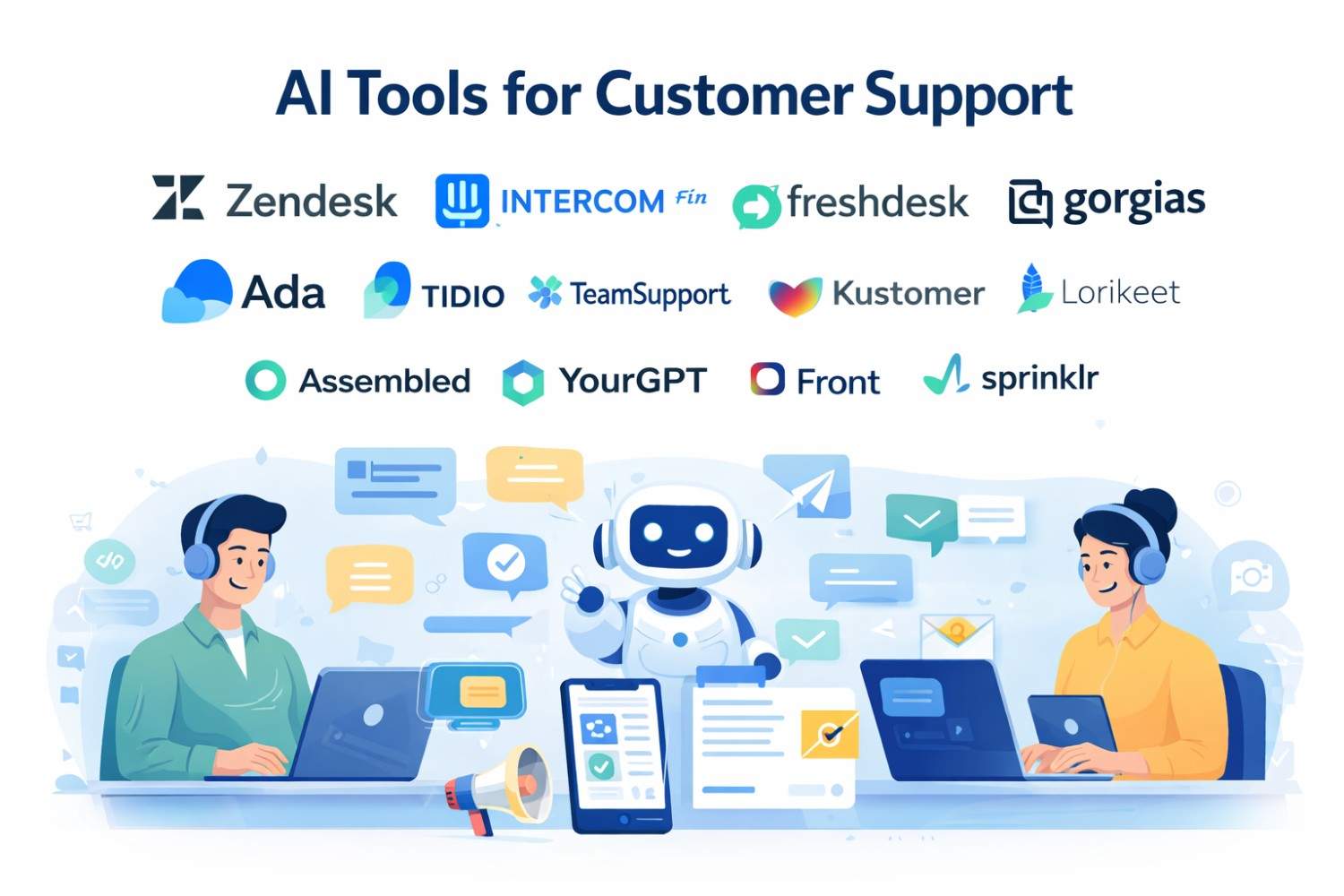
Zendesk AI is one of the strongest options for enterprise teams that need omnichannel support, large-scale ticketing, and strong agent assistance. It is known for intent detection, routing, and integration with broader support operations. For organizations that already run complex helpdesk workflows, Zendesk AI is often a top contender.
Intercom Fin
Intercom Fin is especially popular with SaaS and product-led teams. It is known for fast setup, strong self-service performance, and high autonomous resolution rates that often fall in the 40% to 60%+ range. Its pay-per-resolution model, around $0.99, also makes it easy for many companies to calculate value.
Freshdesk / Freddy AI
Freshworks and Freshdesk with Freddy AI are attractive for SMBs and mid-market businesses. The platform is more no-code friendly, making it easier for teams that want AI without a heavy implementation process. It works well for knowledge-grounded bots, agent assistance, and general support automation.
Gorgias
Gorgias is one of the best-known AI tools for ecommerce support. Its strength comes from deep ecommerce integrations, especially with Shopify and order-related workflows. Brands that deal with shipping questions, returns, and order updates often find Gorgias especially useful.
Other Notable Tools
Other important names in the 2026 market include Ada, Tidio, TeamSupport, Kustomer, Lorikeet, Assembled, YourGPT, Front, and Sprinklr. Some focus on AI-native autonomous resolution, while others stand out for team coordination, unified CX, or simpler SMB implementation.
What Features to Look For
The best AI tool depends on your support model, but a few features matter almost everywhere.
Look for omnichannel coverage, strong knowledge base grounding, CRM and helpdesk integrations, and clear human handoff options. Analytics also matter. You need to measure resolution rate, containment, CSAT, escalation patterns, and deflection to know whether the tool is working.
Another growing priority is backend action capability. Many businesses now want AI agents that can do things, not just answer questions. That includes checking order status, updating account details, processing simple requests, or triggering workflows inside connected systems.
How to Choose the Right AI Tool
Start with your support volume and business type. A SaaS company, a Shopify brand, and an enterprise contact center usually need different tools.
Then look at the pricing model. Some platforms charge by seat, some by usage, and some by successful resolution. From there, compare setup difficulty, integration options, and the quality of reporting.
Most importantly, test actual outcomes. Strong AI customer service software should improve resolution rates, reduce handling time, and support human agents instead of creating more complexity.
Emerging Trends in 2026
The next wave of ai tools for customer support is moving toward agentic AI, voice AI, proactive support, and real-time sentiment analysis. Hybrid human-AI workflows are also becoming more important. Instead of replacing teams, the best systems now combine automation with smooth handoff and agent guidance.
Final Thoughts
AI tools for customer support are growing fast because they solve real business problems. They help companies reduce costs, answer faster, scale across channels, and improve customer experience without adding the same level of headcount.
With markets expanding at 23% to 26% CAGR, routine interactions increasingly handled by AI, and ROI often reaching 3.5x to 8x, 2026 is a strong time to evaluate adoption. Whether you choose Zendesk AI, Intercom Fin, Freshdesk, Gorgias, or another platform, the best choice is the one that fits your workflows, integrations, and customer expectations.
Contact us for any questions info@saastoolsguide.com