AI writing tools are moving faster than ever. What started as simple text generators has turned into a crowded, competitive market filled with smarter assistants, SEO integrations, brand voice controls, and multimodal features. For writers, marketers, bloggers, and agencies, keeping up with AI writing tools updates is no longer optional. It is part of staying productive and competitive.
This growing interest makes sense. The global AI writing tool and assistant software market was worth about USD 1.7 billion in 2023. In 2024, estimates placed it between USD 1.5 billion and USD 2.3 billion, and one projection puts the market at around USD 4.2 billion in 2026. Longer-term forecasts suggest the sector could reach between USD 8.3 billion and USD 12.3 billion by 2030 to 2032, with most growth estimates clustering around an 18.5% to 25%+ CAGR. On top of that, year-over-year growth in 2026 is estimated at roughly 32%, and there are now more than 500 AI writing tools available.
That level of expansion explains why update-focused content is becoming more valuable. People are not just searching for “AI writing tools” anymore. They want to know what changed, what improved, what new features matter, and which platforms are worth using now.
Why AI Writing Tools Updates Matter More Than Ever
The biggest shift in 2025 and 2026 is that AI writing platforms are no longer competing only on text quality. They are competing on workflow.
Users now expect more than a draft generator. They want tools that can help with ideation, outlines, SEO planning, brand consistency, editing, repurposing, and even content performance. That is why updates matter. A tool that was average a year ago may now be one of the most useful in your stack because of new integrations or better model performance.
Adoption numbers show how mainstream this space has become. About 97% of content marketers plan to use AI to support content efforts in 2026, up from 90% in 2025 and 64.7% in 2023. Their top use cases include ideation at 74%, outlining at 61%, drafting at 44%, and editing at 38%, which doubled year over year. More broadly, 44% of marketers use AI tools specifically to generate content. At the business level, 78% of companies globally have adopted AI technologies, and 89% of small businesses use AI for everyday tasks such as email writing, marketing copy, and product descriptions.
These numbers tell a clear story. AI writing is no longer a novelty. It is part of how modern content gets made.
The Biggest AI Writing Tools Updates in 2026
The most important AI writing tools updates in 2026 can be grouped into a few major categories.
1. Faster model releases
Most top tools now improve more frequently. Instead of waiting for large yearly upgrades, users are seeing smaller but meaningful improvements throughout the year. This includes better reasoning, cleaner formatting, stronger prompt following, and more natural brand-safe writing.
This matters because content teams need reliability. If a platform keeps improving output quality and reduces editing time, it quickly becomes more valuable than a tool that only looks good on a pricing page.
2. Better SEO integration
SEO is now a core part of many AI writing platforms. Instead of writing first and optimizing later, many tools now help users build content around keyword intent from the start.
This includes features like keyword clustering, content scoring, SERP analysis, topic gap suggestions, competitor structure review, and real-time optimization tips. For bloggers and niche site owners, this is one of the most practical improvements. It shortens the gap between content creation and ranking strategy.
3. Multimodal capabilities
Text-only tools are no longer enough for many users. One of the biggest AI writing tools updates is the move toward multimodal workflows. That means tools can now support text alongside images, voice, PDFs, screenshots, video scripts, and visual prompts.
For example, a user might upload research notes, a landing page screenshot, or a product brief and ask the tool to create blog content, ad copy, social posts, and email sequences from the same input. That makes AI writing tools more useful across full marketing workflows.
4. Brand voice and team controls
As more companies use AI for public-facing content, consistency has become a major concern. New updates are focused on brand voice training, style guides, team collaboration, approval workflows, and reusable content rules.
This is especially important for agencies and growing businesses. They do not just need fast output. They need output that sounds like them.
5. Compliance and trust features
Enterprise buyers are paying more attention to privacy, plagiarism checks, permissions, and review systems. Because of that, many AI writing tools are adding stronger governance features.
This includes content history, admin controls, citation support, plagiarism scanning, and safer workspace settings. In 2026, trust is becoming a real product feature, not just a legal page checkbox.
Which Tools Are Driving the Most Attention?
Several platforms continue to shape the market conversation around AI writing tools updates.
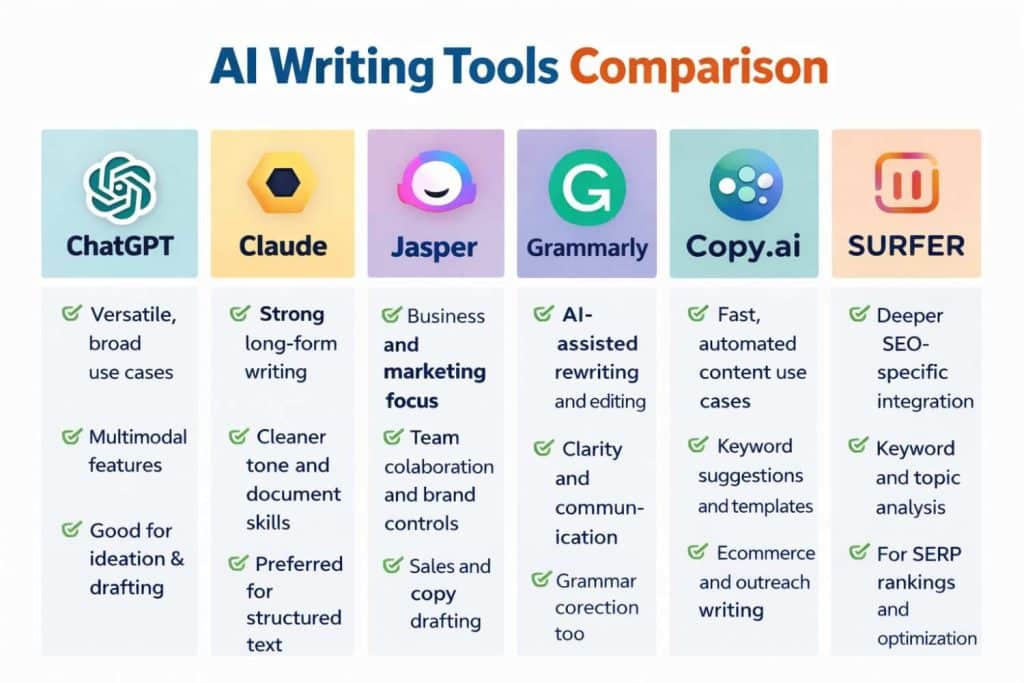
ChatGPT remains one of the most talked-about tools because of its broad use cases, flexible writing support, and expanding multimodal abilities. It is often used for ideation, outlining, rewriting, summarizing, and long-form drafting.
Claude is gaining attention for thoughtful long-form writing, cleaner tone control, and strong document handling. Many users prefer it for research-heavy content and structured writing tasks.
Jasper stays relevant by focusing on business writing, team workflows, and marketing use cases. It appeals to brands that want repeatable content systems rather than casual prompting.
Grammarly continues evolving beyond grammar correction into AI-assisted rewriting, clarity improvements, and workplace communication support.
Copy.ai focuses on speed, automation, and sales-marketing workflows, making it attractive for teams handling repetitive content tasks.
Surfer stands out where SEO content matters most. Its updates often attract publishers and content marketers who care about rankings, optimization, and content structure.
The market is also moving toward specialization. Instead of one-size-fits-all platforms, more users now choose tools based on the exact type of writing they do, such as blog SEO, ecommerce copy, cold outreach, academic writing, or internal documentation.
What Users Actually Want From These Updates
Not every new feature matters equally. Most users care about results, not hype.
The best AI writing tools updates solve practical problems like these:
- Reducing research and drafting time
- Improving output quality without heavy rewriting
- Matching a specific tone or brand voice
- Helping content rank in search
- Turning one piece of content into many formats
- Making collaboration easier for teams
- Cutting repetitive writing work
This is why usage keeps growing. Writing and editing text remains one of the top everyday use cases for AI. It fits naturally into email, blogging, social media, landing pages, product descriptions, and campaign planning.
The productivity effect is also hard to ignore. Among organizations investing in AI, 96% report productivity gains, and 57% describe those gains as significant. For many teams, those gains directly affect revenue because faster content production means more campaigns, better publishing consistency, and lower operational cost.
Key Trends Shaping the Next Wave of Updates
Looking at the current direction of the market, a few trends stand out.
First, platforms are becoming more specialized. Rather than trying to do everything, many tools are getting better at one core job. That is good news for users because it creates better-fit solutions.
Second, human editing is still essential. Even though AI output keeps improving, the winning workflow is still AI-assisted, not AI-only. The strongest content usually comes from a mix of human strategy and AI speed.
Third, SEO-focused writing will keep evolving. Search engines are rewarding useful, experience-based, audience-first content. That means AI tools will need to do more than generate keywords and paragraphs. They will need to help users create content with depth, relevance, and structure.
Fourth, multimodal content production will become normal. The line between writing tool, content assistant, and marketing platform is getting thinner. More updates will connect writing with design, research, video scripting, and publishing.
How to Choose the Right Tool in 2026
If you are comparing platforms, do not choose based only on popularity. Choose based on your workflow.
If you write blog posts and care about rankings, prioritize SEO features and outline support. If you manage a team, look for collaboration and brand controls. If you create high volumes of short-form copy, speed and templates may matter more. If you work on long-form strategy content, document handling and reasoning quality may be more important.
It also helps to test tools using the same prompt set. Compare how each one handles structure, clarity, accuracy, and tone. The best option is usually the one that saves the most editing time while still sounding human and useful.
Final Thoughts on AI Writing Tools Updates
The phrase ai writing tools updates reflects a real shift in user behavior. People no longer want static “best tools” lists. They want timely insights into what changed and what those changes mean for real work.
That demand is backed by a fast-growing market, widespread adoption, and a crowded ecosystem of more than 500 tools. With the sector projected to keep expanding at 20%+ annual growth and marketers using AI at near-universal rates, update-focused content will only become more relevant.
In 2026, the biggest winners are not just the tools with the smartest models. They are the ones that fit naturally into the way people actually write, edit, optimize, and publish. For creators and businesses alike, staying current with AI writing tools updates is one of the smartest ways to work faster without losing quality.
Know more about ai tools