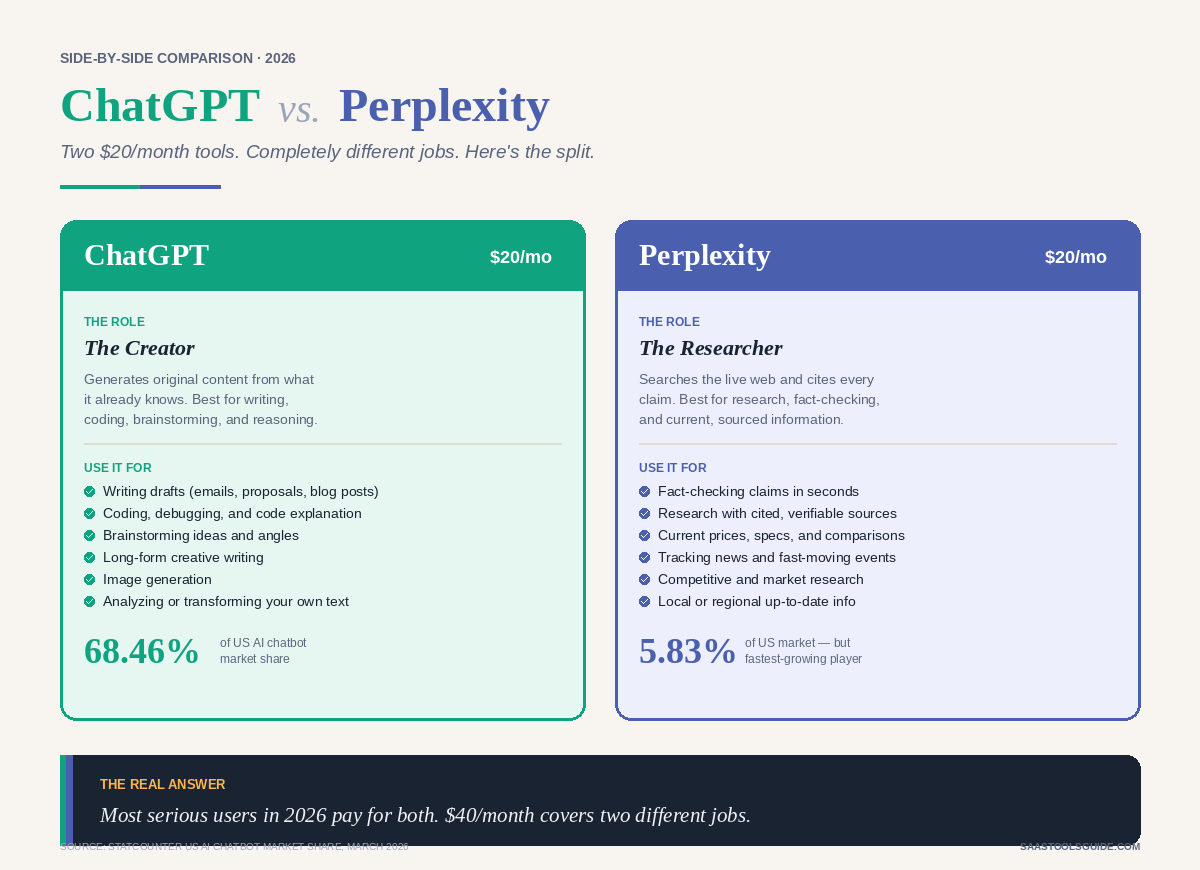
Here’s the short answer most comparison articles won’t give you directly: ChatGPT and Perplexity are not competitors. They’re different tools that happen to both have a chat interface. ChatGPT creates. Perplexity researches. Trying to pick one is like asking whether to keep your microwave or your oven — the answer for most Americans who actually use AI for work is “both, at different moments.”
But if you must pick one, the honest answer depends on what you do in a typical week. By the end of this article, you’ll know which one fits your workflow, what the actual US usage data says about how people are using each, and the specific tasks where one clearly beats the other.
The One Sentence That Explains Everything
ChatGPT generates answers from what it already knows. Perplexity searches the live web and cites where every answer came from.
That architectural difference drives every other difference — price feels similar, features overlap at the edges, but the core behavior is completely different. ChatGPT is a language model that can optionally search. Perplexity is a search engine that uses language models to explain what it found.
If you remember nothing else from this article, remember that sentence. It tells you which tool to open for any given task.
How Americans Are Actually Using Each Tool
Before we get into when to use which, it’s worth looking at where people have actually landed. Market share data tells you something prescriptive — what the crowd has already figured out through trial and error.
As of March 2026, ChatGPT holds 68.46% of the US AI chatbot market according to Statcounter’s US AI chatbot market share data. Perplexity holds 5.83%. Google Gemini sits at 11.76%.
That 12x gap sounds lopsided, but it hides something important: Perplexity’s 5.83% is concentrated among specific professional segments — researchers, journalists, marketers, students, and knowledge workers who care about citations. It’s also the fastest-growing player in the AI search category, with its ARR jumping roughly 50% in a single month in early 2026.
The scale numbers make the positioning clearer:
- ChatGPT has around 900 million weekly active users globally as of February 2026, with roughly 205 million Americans interacting with it regularly
- Perplexity has 30–45 million monthly active users globally (higher with integrations), with an estimated 8–10 million direct US users
- ChatGPT processes 5.35–6.1 billion monthly visits; Perplexity processes 170–240 million — a 25:1 ratio
What this means practically: if you’re reading this, statistically ChatGPT is probably already in your toolkit or you’ve at least tried it. Perplexity is the tool you haven’t added yet but might benefit from. The interesting question isn’t “ChatGPT or Perplexity” — it’s “should you add Perplexity to your existing ChatGPT workflow?”
For many serious US professionals in 2026, the answer has been yes.
When Perplexity Is Flat-Out Better Than ChatGPT
There are specific tasks where Perplexity isn’t just marginally better — it’s the only reasonable choice. These all share a common trait: you need the answer to be verifiably current and sourced.
Fact-checking claims. Someone on LinkedIn says “ChatGPT now serves one billion weekly users” — is that true? Perplexity returns a direct answer with three linked sources in about four seconds. ChatGPT will confidently answer from training data that might be eight months old.
Comparing current products, prices, or specifications. “What’s the current entry-level price of a 2026 Tesla Model 3?” Perplexity gets this right. ChatGPT might give you 2024 pricing without warning you.
Research with citations required. Students, analysts, journalists, and lawyers cannot submit AI output that says “trust me.” Perplexity’s every-answer-is-sourced behavior is table stakes for anyone who needs to defend their work. This is also the reason it’s been gaining traction in regulated industries like healthcare and finance — the audit trail is built into every response.
Tracking fast-moving news or events. Funding rounds, product launches, regulatory changes, sports scores — anything that happened this week. Perplexity’s live search architecture handles this natively; ChatGPT’s web browsing layer is slower and more error-prone.
Competitive research. If you want to know what three competitors are charging right now, what features they’ve shipped this quarter, or what press they’ve received — Perplexity returns a synthesized, sourced answer in one query. In ChatGPT, you’re prompting multiple times and still hoping the browsing tool engaged properly.
Local or regional information. “What are the top-rated Italian restaurants in Austin this year?” Perplexity checks live sources. ChatGPT, unless specifically told to browse, will pattern-match from old training data.
There’s a common pattern in all of these: they’re questions where being approximately right but confidently outdated is worse than being slightly slower but citeable. That’s Perplexity’s zone.
When ChatGPT Is Flat-Out Better Than Perplexity
Flip the same logic. There are tasks where being able to generate original, creative, context-aware output matters more than being sourced and current. ChatGPT is dramatically better at all of these.
Writing first drafts of anything. Emails, proposals, blog posts, cover letters, SOPs, product descriptions. ChatGPT produces natural, structured, tonally-appropriate prose from a short prompt. Perplexity can write, but its output reads like a well-cited Wikipedia summary — because that’s fundamentally what it’s generating.
Code generation, debugging, and explanation. ChatGPT’s reasoning on complex codebases, architectural decisions, and debugging is genuinely strong. Research published in the journal Science found professionals using tools like ChatGPT completed writing tasks 40% faster with 18% higher quality — a pattern that holds for structured work like code too. Perplexity can search Stack Overflow for you, but the moment you need to reason through “why isn’t this async function resolving in this specific context,” ChatGPT is the tool.
Brainstorming and ideation. “Give me 15 angles for a blog post about small business AI tools.” ChatGPT will give you 15 creative, varied angles. Perplexity will find articles that already exist on the topic, which is the opposite of what you asked for.
Long-form creative writing. Fiction, personal essays, scripts, marketing copy with voice — anywhere original generation with style and tone control matters.
Conversational problem-solving. Multi-turn dialogue where the model builds on what you said three messages ago. ChatGPT’s conversation memory and reasoning over long exchanges is structurally better than Perplexity’s, which is optimized for one-shot answers.
Image generation. ChatGPT generates images natively through GPT Image. Perplexity has limited image generation but it’s not the tool’s strength.
Transforming or analyzing text you provide. “Summarize this 40-page PDF,” “rewrite this email in a warmer tone,” “extract the key action items from this meeting transcript.” ChatGPT is purpose-built for this. Perplexity can do it, but it’s overkill — you don’t need a search engine for a summarization task.
The Pricing Question Most People Ask Wrong
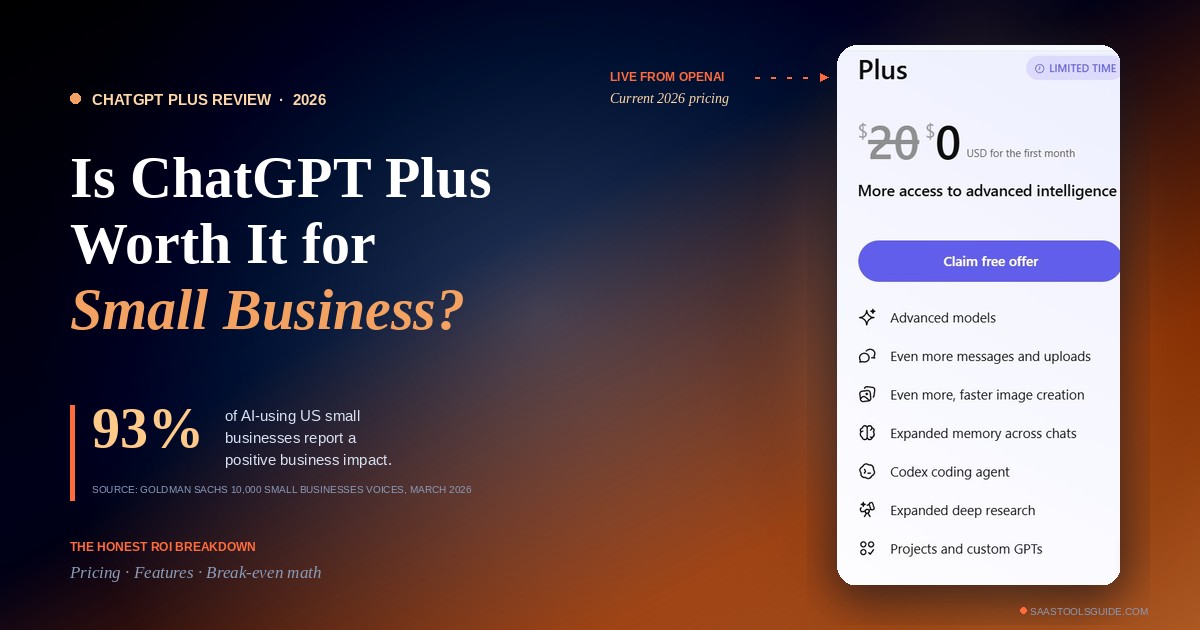
Both tools are $20/month for the main paid tier. At the same price, people assume they should pick one. That framing misses the point.
ChatGPT Plus at $20/month unlocks GPT-5.4, image generation, voice mode, custom GPTs, and higher usage limits. Perplexity Pro at $20/month unlocks over 300 Pro searches per day, access to premium models (GPT-5, Claude Opus 4.7, and others) inside Perplexity, unlimited file uploads, and an ad-free experience.
A comparison that matters more than “which $20 is better spent”:
- If you’ll use an AI tool fewer than 3 times a week, stay on both free tiers. They’re genuinely capable in 2026.
- If you write, code, or create content regularly, ChatGPT Plus is the better single subscription at $20/month.
- If your work is research-heavy — journalism, analysis, academic, competitive intelligence — Perplexity Pro is the better single subscription at $20/month.
- If you do both creation and research for a living, the $40/month combined subscription is one of the highest-ROI decisions available in 2026. Most serious US professionals I’ve seen navigate this question end up there.
For teams, the pricing diverges more. ChatGPT’s Team plan is $25/user/month. Perplexity’s Pro tier is higher at roughly $40/user/month, but includes default-private data handling and stricter no-training guarantees — meaningful for regulated industries like healthcare and finance. For small business teams, this usually nudges the decision toward ChatGPT Team unless data privacy is a specific compliance requirement. Business-tier conversations at both OpenAI and Perplexity are contractually excluded from model training by default.
The Real Question: Should You Use Both?
Every serious comparison eventually lands on the same answer: power users don’t pick. They switch. And the data backs it up.
The workflow most knowledge workers converge on, whether they verbalize it or not:
- Start in Perplexity when you need context. What’s true right now? What have competitors done recently? What does the current data say?
- Move to ChatGPT when you need to create. Write the proposal, draft the email, build the presentation, code the feature — using the context you pulled from Perplexity as raw material.
- Return to Perplexity to verify. Before you send or ship, spot-check the claims that matter. This is where Perplexity’s citation-backed answers earn their $20/month.
That three-step loop — research, create, verify — is how most Americans doing AI-assisted knowledge work operate in 2026. It’s also why the 900-million-WAU ChatGPT and the 45-million-MAU Perplexity aren’t really competing for the same slot in a user’s toolkit. They’re occupying adjacent slots.
A Decision You Can Actually Make in 30 Seconds
Forget the tables and the frameworks. Here’s the test:
In a typical week, which of these sentences describes more of your time?
- “I need to figure out what’s true about X.” → You’ll get more value from Perplexity.
- “I need to produce something — writing, code, ideas, images.” → You’ll get more value from ChatGPT.
- “I do both about equally.” → Pay for both. $40/month covers two different jobs.
If you’re still genuinely unsure, use the free tiers of both for two weeks. Track which one you reach for more often. The answer reveals itself within a handful of sessions — usually faster than you’d expect.
Where Each Tool Is Heading in 2026
A quick note on momentum, because where these tools are going matters as much as where they are right now.
ChatGPT’s market share has slipped from peaks above 80% down to its current ~68% in the US as Gemini and others have gained ground. Independent analysis of the market suggests ChatGPT’s dominance fell roughly 19 percentage points in twelve months. It’s still the overwhelming leader, but the “default AI” slot is more contested than it was eighteen months ago. OpenAI’s response has been to expand aggressively into agents, voice, image generation, and enterprise — trying to be the AI operating system rather than just a chatbot.
Perplexity is growing in the opposite pattern: smaller base, explosive rate. User counts roughly doubled in 2025, ARR is up dramatically, and it’s signing enterprise deals in regulated industries faster than analysts expected. It’s not trying to be everything — it’s trying to own the “sourced answers” category completely. That narrower focus is a feature, not a weakness.
The practical takeaway: both tools are going to keep getting better at what they’re already good at. ChatGPT will keep widening its lead in creation and reasoning. Perplexity will keep widening its lead in sourced research. The gap between them will probably grow, not shrink — which means the “use both” answer becomes more correct over time, not less.
The Honest Bottom Line
If you insisted on a single recommendation for a typical US small business owner, freelancer, or professional in 2026: ChatGPT Plus at $20/month, backed by Perplexity’s free tier for research and fact-checking. That combination costs $20/month, covers 80% of real-world use cases, and gives you an on-ramp to add Perplexity Pro the moment you notice you’re hitting its free-tier limits.
If you’re already paying for ChatGPT and your work involves any serious research, journalism, analysis, or competitive intelligence: add Perplexity Pro. The $40/month combined spend pays for itself in one hour of research time saved per month.
If you’re a casual user who uses AI a few times a week for quick questions: stay on both free tiers. You don’t need to pay anything in 2026 to get meaningful value from either of these tools.
The mistake to avoid is picking one and assuming it covers both jobs. It doesn’t. ChatGPT is not a great research tool, and Perplexity is not a great creation tool. They’re excellent at their own things, and the people getting the most out of AI in 2026 have figured out which to open when.
Did you get your answer for ChatGPT vs Perplexity: Which Should You Use ?
For more AI tool breakdowns grounded in actual usage data, see our guide to the best AI tools for solopreneurs in 2026.