Most “best AI tools for entrepreneurs” lists hand you 30 names and a shopping cart. That’s useless. Entrepreneurs don’t fail because they didn’t find the right tool — they fail because they spread thin across twelve tools that each move nothing, while their competitors went deep on two that moved revenue.
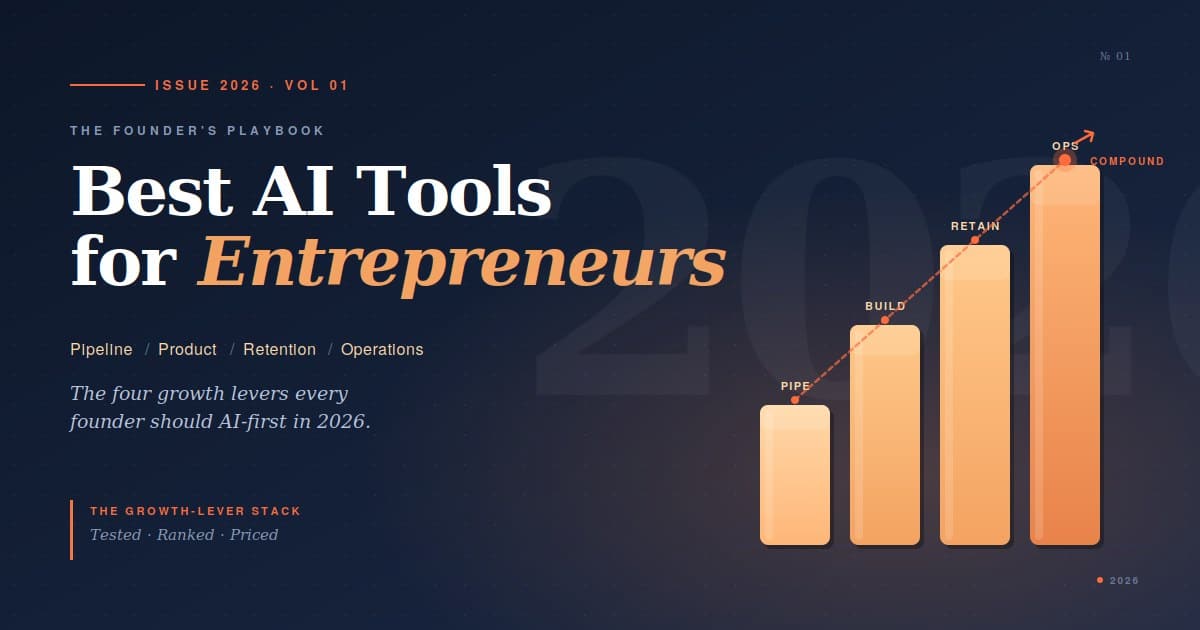
This piece is built on a different premise. Instead of listing tools by category, it’s organized by the four levers that actually move an entrepreneur’s business: Pipeline, Product, Retention, and Operations. For each lever, you get the specific AI tools that are producing measurable results right now in 2026 — and the ones to ignore.
The unfair advantage in 2026 isn’t “having AI.” It’s picking which part of your business you’re going to 10x while your competitors are still evaluating demos.
Running a one-person business instead of scaling a team? Our companion guide on the best AI tools for solopreneurs in 2026 covers the lean stack built for solo operators.
The Baseline Assumption (Skip If You Know This)
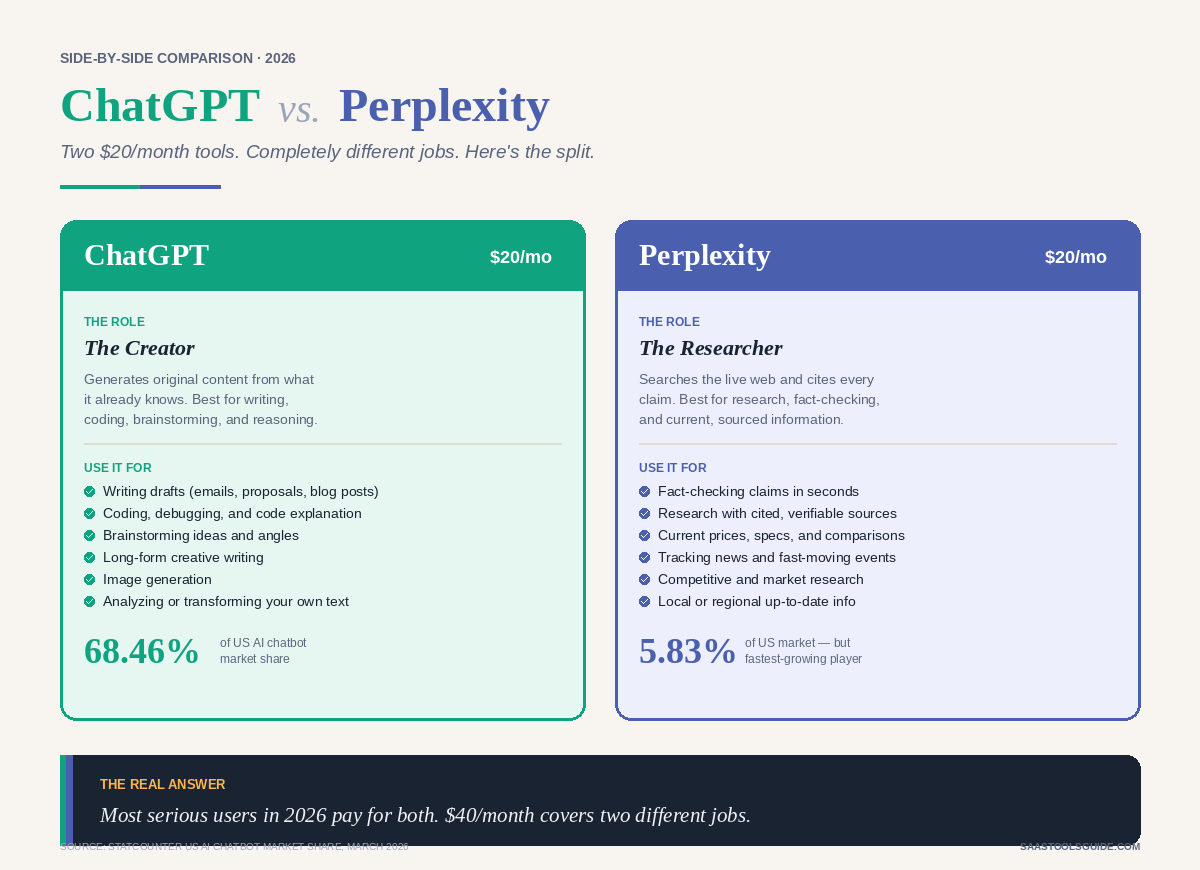
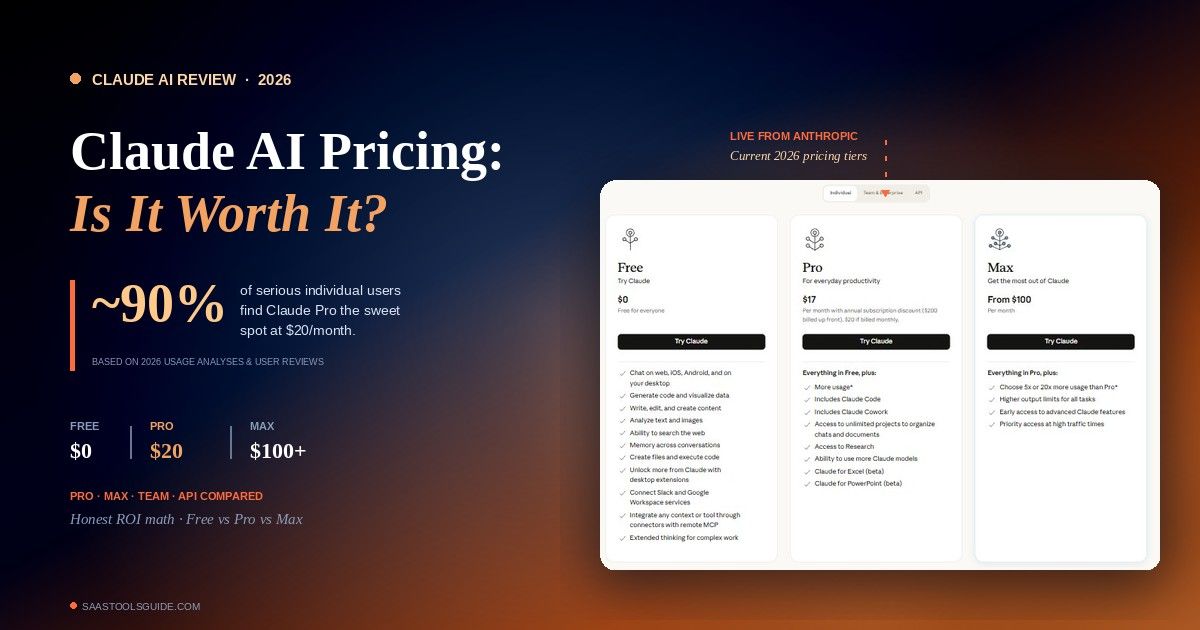
Every serious entrepreneur in 2026 has a generalist AI assistant in their daily workflow — typically Claude Pro or ChatGPT Plus, often both, plus Perplexity for research. At $40–$60/month, that combination is table stakes, not strategy. It’s the equivalent of having email. We’re not spending time on it here.
What separates the entrepreneurs who compound from the ones who stall is what comes after the baseline. That’s the rest of this guide.
Lever 1: Pipeline — Finding and Closing Revenue
If your business isn’t constrained by pipeline, skip this section. If it is, this is the highest-ROI lever you can pull in 2026.
Clay — The Category-Defining Go-to-Market Tool
Clay raised at a $3.1B valuation in 2025 for a reason. It’s a spreadsheet-shaped AI that enriches lead data from 100+ sources, writes personalized outreach at scale, and finds signals (job changes, funding rounds, tech installs) that trigger the right message at the right time. OpenAI and Canva use it. For founder-led sales, it replaces what used to require a 5-person SDR team.
Pricing: Starter $149/month, scales up based on credits Use it when: Your outbound needs to be personalized and you’d otherwise hire an SDR Don’t use it when: Your ACV is under $5K or you’re not doing outbound at all
Gong or Chorus — Revenue Intelligence for Founder-Led Sales
Gong records every sales call, transcribes it, and pulls out what actually moves deals — which objections correlate with losses, which phrases correlate with wins, what competitors get mentioned. For founders who are still the top salesperson, this is the closest thing to having a VP of Sales coach you after every call.
Pricing: Custom, typically $1,000–$1,500/user/year at minimum Use it when: You’re doing 10+ demos/week and want compounding improvement Don’t use it when: You’re pre-product-market-fit or your ACV doesn’t justify the cost
Lemlist or Smartlead — AI Cold Email That Doesn’t Get Filtered
Cold email deliverability got much harder in 2024 after Google and Yahoo tightened sender rules. Lemlist and Smartlead‘s AI features (warm-up, personalization at scale, deliverability monitoring) are how small teams still run outbound that actually lands in inboxes in 2026.
Pricing: Lemlist from $39/month, Smartlead from $39/month Use it when: You’re sending 500+ cold emails/month Don’t use it when: You’re in a regulated space where cold outreach creates risk
HubSpot Breeze or Salesforce Agentforce — AI-Native CRM Layer
The big CRMs finally shipped AI that isn’t theatrical. HubSpot’s Breeze and Salesforce’s Agentforce can draft emails grounded in actual deal context, score leads based on behavior, and forecast pipeline with better-than-sales-rep accuracy. Agentforce in particular is Salesforce’s bet on fully autonomous sales agents and is worth evaluating if you’re already in that ecosystem.
Pricing: HubSpot from $20/seat, Salesforce Starter from $25/seat
The honest take on this lever: Most entrepreneurs should pick exactly one of Clay or Apollo for top-of-funnel plus one of HubSpot or Attio as the system of record. Adding a third tool here creates a data mess and rarely adds revenue.
Lever 2: Product — Building Faster Than Your Competitors
This lever only applies if you ship software. If you don’t, skip to Lever 3.
Cursor — The Default AI Code Editor
The engineering teams shipping fastest in 2026 are almost uniformly on Cursor. Anysphere (the company behind it) is one of the fastest-growing startups in the world because the productivity gains are real — serious engineers report shipping 2–3x faster on well-scoped work.
Pricing: Hobby free, Pro $20/month, Business $40/user/month
Claude Code — Agentic Development in the Terminal
Where Cursor is an editor that helps you code, Claude Code is more like an engineer you hand a task. Specify a feature, let it plan and execute across multiple files, review the diff, merge. For founders who are technical enough to work in a terminal but don’t want to hire an engineer yet, this is genuinely a way to ship production-grade product solo.
Pricing: Included with Claude Pro ($20/month); heavier use on Max tiers
Lovable or v0 — Non-Technical Founder Prototyping
Describe a feature in plain English, get a working app with a hosted URL. Lovable and Vercel’s v0 have improved meaningfully in 2026. Not suitable for production-scale SaaS, but excellent for MVPs, internal tools, and customer-facing prototypes that validate demand before you commit engineering resources.
Pricing: Both have free tiers; paid from $20/month
Statsig or Eppo — AI-Powered Experimentation
The moat for AI-native product companies in 2026 isn’t having AI features. It’s testing them faster than competitors. Statsig and Eppo run feature flags, A/B tests, and experiment analysis with AI that auto-surfaces what’s working and what’s not.
Pricing: Statsig free tier is very generous for early-stage; Eppo custom
Linear — AI-Native Issue Tracking
Linear quietly became the default for product teams who ship. Its AI features (triage, auto-summaries, issue drafting) remove about 20% of the meta-work around shipping. Worth the switch even if Jira already works.
Pricing: Free up to 250 issues, Standard $10/user/month
Lever 3: Retention — Keeping the Revenue You’ve Won
Most entrepreneurs under-invest here until they’re bleeding churn at Series A. Don’t be that founder. Set this up before you need it.
Intercom Fin — The AI Support Agent That Actually Resolves Tickets
Fin autonomously resolves a reported 50%+ of support tickets — not deflects, resolves. The per-resolution pricing (~$0.99) means you pay only for outcomes, which aligns incentives better than most AI pricing models. For any entrepreneur past product-market fit, this defers the first support hire by 6–12 months.
Pricing: $0.99 per resolution + Intercom base plan from $39/seat
Pendo with AI — Product Analytics That Surface What to Fix
Pendo‘s AI insights don’t just tell you what users are doing; they highlight the specific UX patterns correlated with churn, upgrade, and activation. For PLG companies, this is where product decisions come from.
Pricing: Free starter tier, paid plans custom (typically $7K+/year)
Dovetail — AI Customer Research Repository
Dovetail ingests every customer interview, support ticket, sales call, and NPS response, then surfaces patterns automatically. Instead of reading 50 interviews, you query “what’s the top objection from mid-market prospects” and get a sourced answer in seconds. Transformative for product teams.
Pricing: Free starter, Professional from $30/user/month
Catalyst or Gainsight — Customer Success Ops
Once you’re past ~$1M ARR with B2B customers, retention becomes an ops problem. Catalyst (acquired by Totango in 2024) and Gainsight track account health signals and surface churn risk before it happens. The AI layers in 2026 finally made these tools usable at seed-stage scale, not just enterprise.
Pricing: Custom; typically $10K+/year
Lever 4: Operations — The Boring Work That Creates Capital Efficiency
Operations is where most entrepreneur AI-tool lists get lazy (“use Zapier!”). Actually capital-efficient founders go deeper.
Zeni — AI-First Finance Team in a Box
Zeni combines AI bookkeeping with human finance expertise — daily dashboards on burn, runway, and expense anomalies, plus month-end close and tax prep. For any US entrepreneur with institutional capital, the board-reporting rigor alone pays for it.
Pricing: From $549/month Alternative for pre-seed: QuickBooks Online with Intuit Assist (from $30/month)
Harvey or Spellbook — Legal AI
Harvey is the $8B-valued legal AI that more than half of the top 100 US law firms now use — but it’s also increasingly available to in-house legal functions at startups. For earlier-stage entrepreneurs, Spellbook is the more accessible option: it lives inside Microsoft Word and reviews contracts the way a junior lawyer would, at a fraction of the cost.
Pricing: Harvey is custom and enterprise-priced. Spellbook from $89/user/month Use it for: Contract review, term sheet analysis, NDA standardization Don’t use it for: Litigation, regulated industries, anything where legal liability is real — hire a lawyer
Ashby or Gem — AI Recruiting
Hiring is where AI creates immediate, quantifiable leverage. Ashby is the ATS that modern hiring teams have standardized on, with AI for candidate scoring, interview kit generation, and pipeline analytics. Gem adds AI-powered outbound to passive candidates. Together they cut time-to-hire roughly in half.
Pricing: Ashby from ~$400/month for small teams, Gem custom Use it when: You’re hiring 3+ roles in the next 6 months
Causal or Runway — Financial Modeling
Spreadsheets break at scale. Causal and Runway (the financial planning platform, not the video tool) are AI-first financial modeling platforms built for operators. Scenario planning, headcount models, and board-ready forecasts without 40-tab Excel files.
Pricing: Causal from $50/month, Runway from $1,500/month
Hex — AI-Powered Data Analysis
For founders who actually look at their data (you should), Hex has become the fastest way to get from “I have a question” to “I have a dashboard.” Ask a question in English, get a SQL query, visualization, and shareable notebook. Replaces a good chunk of what analysts used to do.
Pricing: Free tier, Professional from $24/user/month
Entrepreneur Archetype Stacks: Pick the One That’s Actually You
Generic “stage-based” stacks miss the point. A bootstrapped agency owner and a VC-backed SaaS founder have completely different needs at the same revenue. Here are the four archetypes most entrepreneurs fall into and what their stack should actually look like.
The B2B SaaS Founder
Pipeline is the bottleneck. Product quality is the moat. Retention is the exit.
- Clay + HubSpot (pipeline) — $250+/month
- Cursor + Linear + Statsig (product) — $50+/user/month
- Intercom Fin + Dovetail (retention) — $100+/month + usage
- Zeni (ops) — $549/month
- Typical spend at seed stage: $1,500–$3,000/month
The E-commerce Entrepreneur
Paid acquisition is the bottleneck. Conversion rate is the moat. Repeat purchase is the exit.
- Klaviyo AI (email/SMS flows) + Meta / Google AI ads (acquisition)
- Shopify Magic (on-store AI features, free with Shopify)
- Triple Whale or Northbeam (AI attribution)
- Gorgias with AI (support specifically for e-com)
- Tidio or Intercom Fin (conversational commerce)
- Typical spend at $1M GMV: $800–$2,000/month
The Agency / Services Owner
Delivery capacity is the bottleneck. Differentiation is the moat. Retainers are the exit.
- Claude Pro + ChatGPT Business (delivery speed)
- AirOps or Distribute (productized AI service delivery)
- HubSpot + Fireflies (client-facing operations)
- Harvest or Toggl with AI (time and profitability tracking)
- Canva Teams + Midjourney (creative delivery)
- Typical spend for a 5-person agency: $500–$1,200/month
The Creator-Turned-Entrepreneur
Attention is the bottleneck. Trust is the moat. Product launches are the exit.
- ChatGPT + Claude (content ideation and writing)
- OpusClip (long-to-short video)
- Beehiiv or Substack (newsletter with AI features)
- Circle or Skool (community, both now with AI moderation)
- Stripe + a course platform (monetization)
- Typical spend at $10K/month revenue: $200–$500/month
What Most Entrepreneurs Get Wrong About AI Tools
Three patterns, observed across hundreds of founders in 2026:
They optimize for tool quantity instead of depth. The entrepreneurs getting the best ROI on AI have fewer tools than their peers, and they use each one in more places. Two deeply-integrated tools beat eight lightly-adopted ones every time.
They adopt tools before they have a process. AI doesn’t create processes; it accelerates the ones you already have. If your sales process is broken, Clay won’t fix it — it’ll just send more broken outreach faster. Fix the process first, add the AI second.
They confuse “using AI” with competitive advantage. In 2026, every competitor has access to the same tools. The advantage isn’t the tool — it’s the proprietary data, context, and workflow you feed it. Spend time on that, not on tool evaluation.
FAQs About Best AI Tools for Entrepreneurs
How do I know when to upgrade from an AI tool to an actual hire? The rule most operators use: when the AI tool is hitting output quality ceilings that are costing revenue, not when the volume gets uncomfortable. A $5K/month AI stack that does 80% of a job is almost always better than a $150K/year hire doing 100% — until quality becomes the constraint, at which point you hire.
Should I worry about my data being trained on by AI providers? For entrepreneurs with sensitive IP or customer data: yes, this is a real concern. Use enterprise or business tiers — Anthropic and OpenAI both contractually exclude business-tier data from training. Avoid consumer tiers for anything sensitive.
What’s the single highest-ROI AI category for bootstrapped entrepreneurs? For most bootstrapped B2B entrepreneurs, it’s AI-powered outbound (Clay or similar). For consumer and content businesses, it’s AI content/creative production. Pipeline or attention — pick whichever is actually your bottleneck.
How do I handle AI tool sprawl across a 10-person team? Make one person accountable per tool. Run a monthly “tool audit” asking: is this moving a metric we care about? Cancel anything that fails the test two months in a row. Most teams can cut 30–40% of their AI spend this way without losing output.
Claude, ChatGPT, or something else as my primary assistant? If you write a lot of long-form strategic work (board updates, investor emails, contracts): Claude. If you need breadth (image generation, voice mode, custom GPTs, broader ecosystem): ChatGPT. Many entrepreneurs pay for both — the combined $40/month is the best productivity investment available right now.
At what revenue should I start investing in the “ops” layer (Zeni, Harvey, Ashby)? Zeni and Ashby typically make sense at ~$500K ARR or institutional funding, whichever comes first. Harvey and similar legal AI usually waits until $2M+ ARR. Until then, QuickBooks, Spellbook, and a good ATS free tier cover the same ground.
The Bottom Line
The entrepreneurs who’ll compound in 2026 aren’t the ones with the biggest AI stack. They’re the ones who picked the right lever — pipeline, product, retention, or operations — and went deep enough on AI there that their competitors can’t catch up.
Don’t try to adopt everything in this guide. Pick your lever. Pick your two tools. Go deep for 90 days. Measure. Then decide what to add.
That’s how capital-efficient companies get built in 2026 — not by buying more software, but by building genuine compounding leverage in one place at a time.